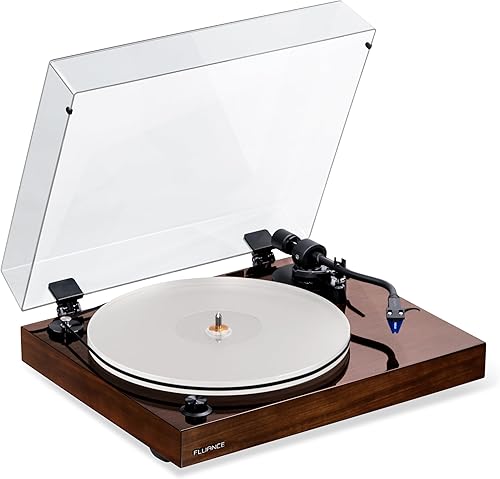
The Fluance RT85 is a belt-drive turntable aimed at people who want hi-fi parts without paying for a boutique brand. Fluance builds the deck around a heavy acrylic platter, a servo-controlled motor and an Ortofon 2M Blue cartridge, and it wraps them in a multi-layer MDF cabinet with a real-wood finish.
We did not handle this turntable ourselves. This profile collects what Fluance publishes and explains what it means for a US buyer. To see where it ranks, read our best turntables of 2026 comparison.
The Short Version
The RT85 is the fifth pick in our lineup and sits in the mid-to-premium range. Its main strengths are the cartridge, the platter and the servo speed control. Its main limitation is the missing phono stage, which is a normal tradeoff at this level. If your amplifier has a phono input you can plug it in directly. If not, you need a preamp.
Key Specs According to Fluance
From Fluance’s product page and specification table:
- Drive: Belt drive with a DC motor and servo controller that checks speed 500 times a second, using an optical sensor.
- Speeds: 33-1/3 and 45 RPM (78 RPM is not supported).
- Wow and flutter: 0.07%.
- Speed variation: 0.10%.
- Signal to noise: 69 dB (weighted).
- Platter: Acrylic, 12 inches across, about 3 lb (1.56 kg), with no mat needed.
- Tonearm: Static-balanced S-type aluminum arm, effective length 8.82 inches (224 mm), effective mass 27.5 g, overhang 0.76 inches, with adjustable anti-skating, a cueing lever and a bayonet-mount headshell.
- Supported cartridge weight: 5.0 to 7.5 g, with an adjustable 102 g counterweight.
- Cartridge: Ortofon 2M Blue moving magnet, 0.3 x 0.7 mil elliptical stylus, 5.5 mV output.
- Outputs: Gold-plated RCA and a ground terminal. No phono preamp, no line output.
- Cabinet: MDF with a high-gloss walnut real-wood veneer and a tinted dust cover.
- Size and weight: About 6 x 16.5 x 14.25 inches and 16.76 lb (7.6 kg).
- Power: 100 to 240 V AC adapter, 12 V / 500 mA.
- In the box: Turntable, dust cover with hinges, bubble level, headshell with the 2M Blue cartridge, acrylic platter and belt, and the power adapter.
- Warranty: Two-year manufacturer’s direct warranty.
Platter and Motor
Fluance says the acrylic platter has high density and mass, which keep the speed steady and absorb vibration. It also says acrylic resists static electricity, which means less dust and better tracking. The platter is recessed in the center so a record lies flat.
The motor is a precision DC unit mounted away from the platter and decoupled from the plinth by a silicone isolation ring, which Fluance says keeps rumble away from the stylus. The servo circuit reads an optical sensor and corrects speed 500 times a second, to a rated wow and flutter of 0.07%.
Ortofon 2M Blue Cartridge
The cartridge is the RT85’s headline part. The 2M Blue has a nude elliptical stylus, which means the diamond is a single piece with a low tip mass. Fluance says that means better resolution and lower surface noise. Its listed output is 5.5 mV, in the range of a moving magnet phono input.
Fluance lists a replacement 2M Blue stylus, so you can renew the tip without replacing the whole cartridge.
Isolation and Cabinet
The cabinet is multi-layer MDF, which Fluance says inhibits the transfer of resonance. Three rubber, spike-type, height-adjustable feet reduce contact with the surface, and Fluance says they give immunity to environmental vibration. A bubble level comes in the box, which makes leveling easy.
The best location is still a solid, level shelf away from the speakers. If a record skips when someone walks by, move the deck to a sturdier spot.
Connecting It in the US
The RT85 has RCA outputs at phono level. Connect it in one of these ways:
- To an amplifier or receiver with a phono input.
- To a phono preamp, such as the Fluance PA10, and from there to a line-level input.
- To powered speakers through a preamp, if the speakers have no phono input.
Fluance warns that the turntable requires a phono preamp to function unless the amplifier has a phono input. The adapter accepts 100 to 240 V, so it works from a US outlet.
Operation
It is a manual deck. The tonearm has a cueing lever that Fluance says allows slow, controlled lowering of the stylus, and a defeatable auto stop that helps to prevent wear. The auto stop is useful for listeners who may fall asleep before a side ends.
Setting It Up and Protecting Your Records
Because the RT85 is a manual deck, a few minutes of care at the start pays off over years of play. Level the cabinet with the bubble level in the box, fit the acrylic platter and the continuous-loop belt, then add the counterweight. Fluance lists the arm as supporting a cartridge of 5.0 to 7.5 g and gives the counterweight an adjustable 102 g range, so the supplied 2M Blue cartridge sits comfortably inside it. Set the tracking force on the counterweight to the figure Ortofon publishes for the 2M Blue and set anti-skate to match, since the arm has an adjustable anti-skate control.
A worn stylus and the wrong tracking force are the two most common causes of damaged grooves, so note when you fitted the stylus and replace it on the maker’s schedule. Keep the stylus clean with a soft brush and keep the dust cover down while a record plays.
How It Compares
In our lineup the RT85 ranks fifth, below the Technics SL-1200MK7 and above the Audio-Technica models. Against the Rega Planar 3 it offers a heavier platter and a servo-regulated motor, though the Rega is the one What Hi-Fi? has long recommended at this level. Against the Technics SL-1500C it needs a phono preamp, but it gives you a belt-drive design and a better cartridge to start with than most budget decks. See the Rega Planar 3 profile and the Technics SL-1500C profile for those approaches.
Pros and Cons
Pros
- Acrylic platter with high mass
- Servo-controlled motor with an optical speed sensor
- Ortofon 2M Blue cartridge, pre-aligned
- Defeatable auto stop
- Real-wood veneer and an isolating MDF cabinet
- Two-year warranty
Cons
- No phono preamp
- No 78 RPM, Bluetooth or USB
- Manual cueing and speed change
- About 17 lb, so it needs a sturdy shelf
Who It Is For
The RT85 suits a listener with an amplifier that has a phono input, who wants a good cartridge and platter without moving to a high-end brand. It also suits someone building a system step by step, since the cartridge and preamp can both be upgraded.
It is not the best choice for a beginner with powered speakers and no preamp, for a DJ, or for a household that wants wireless playback straight out of the box.
Sources