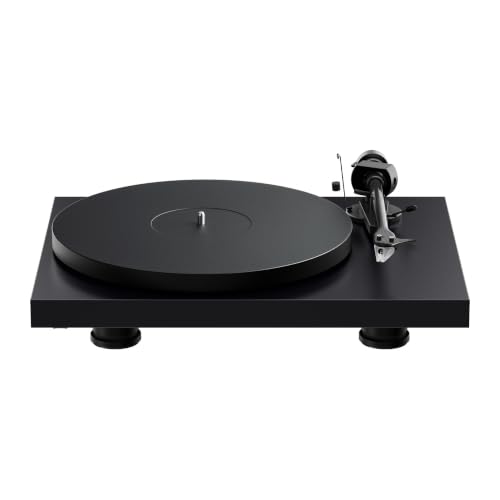
The Pro-Ject Debut EVO 2 is a belt-drive turntable that packs serious hi-fi parts into a small, colorful, minimalist package. Pro-Ject says it focuses on “the core aspects that make a turntable sound great,” and it sells the deck in 10 finishes, from gloss black to satin wine red.
We did not handle this turntable ourselves. This profile collects what Pro-Ject publishes, what What Hi-Fi? and Tom’s Guide reported from their own listening, and the points that matter for a US buyer. To see where the EVO 2 lands, read our best turntables of 2026 ranking.
The Short Version
The Debut EVO 2 is the third pick in our lineup and sits in the mid-to-upper range. Compared with the cheaper all-in-one players, it gives up a built-in phono stage, USB and Bluetooth. In exchange you get a carbon fiber tonearm, a heavy damped platter and a clean path for upgrades. What Hi-Fi? describes it as “an updated version of the five-star Debut Carbon Evo” with parts taken from the Debut Pro.
Pro-Ject says the deck is the successor to that Debut Carbon EVO, which is a useful point if you are comparing used or older stock.
Key Specs According to Pro-Ject
From Pro-Ject’s technical specification:
- Drive: Belt drive with electronic speed control, 33 and 45 RPM.
- Platter: Die-cast aluminum, about 11.8 inches (300 mm) across, with TPE damping and a felt mat, weighing about 3.7 lb (1.7 kg). It is anti-magnetic.
- Bearing: Stainless steel axle in a bronze bushing.
- Wow and flutter: 33 RPM +/-0.16%; 45 RPM +/-0.14%.
- Speed drift: 33 RPM +/-0.40%; 45 RPM +/-0.50%.
- Signal to noise: 68 dB.
- Tonearm: 8.6-inch one-piece carbon fiber arm, effective length about 8.6 inches (218.5 mm), effective mass 7 g, overhang about 0.73 inches (18.5 mm).
- Cartridge: Pick it MM EVO, moving magnet.
- Power: 15 V DC / 0.8 A supply, 4 W in use and 0 W in standby.
- Size and weight: About 16.3 x 4.4 x 12.6 inches (415 x 113 x 320 mm) and 13 lb (6 kg) net.
- In the box: Power supply, dust cover and a 7-inch single adapter. Pro-Ject also lists a Connect it Phono E RCA cable.
What the Parts Do
The platter. A heavy platter keeps the record turning at a steady speed. Pro-Ject says the EVO 2’s aluminum platter has a ring of TPE (thermoplastic elastomer) inside to dampen resonances and keep wow and flutter low. The platter is also precision balanced in an extra step.
The tonearm. The arm is a one-piece carbon fiber tube, which Pro-Ject calls stiff and lightweight. It sits in a machined aluminum bearing block with a smooth, low-friction bearing, and the counterweight has its own TPE damping ring. Tom’s Guide says the arm’s hanging weight handles anti-skating with three settings, which it called effective but a little crude.
The motor. Pro-Ject says an AC motor sits in a suspension system and is fed by a power generator that produces a clean sine wave for steady speed. Tom’s Guide noted that the motor made an audible groan on start-up but settled down quickly.
The cartridge. Pro-Ject developed the Pick it MM EVO with Ortofon, using split pole pins that it says give a flat frequency response comparable to moving coil cartridges. It arrives pre-mounted, so a new owner does not have to align it from scratch.
Operation and Setup
Setting up is quick, according to Tom’s Guide: the deck arrives almost fully built, and its writer was playing records in about five minutes. You fit the platter and belt, add the counterweight, set tracking force with a stylus scale and choose an anti-skate setting. It is all manual. The tonearm lever lets you lower the needle gently, but the platter does not stop by itself at the end of a record.
A rocker switch under the plinth starts the platter and switches speed, so there are no buttons on the top. That is neat to look at, but you will reach underneath to change from 33 to 45 RPM. What Hi-Fi? said that is still more convenient than Rega’s Planar 2, where you move the belt by hand.
Connections
Pro-Ject built the RCA output box and the power socket into the plinth, which makes the cables easier to reach. The gold-plated RCA sockets let you swap in a better phono cable later, and Pro-Ject offers a True Balanced connection for owners with a compatible cartridge and phono stage.
For a typical US setup you need either a receiver or amplifier with a phono input, or a separate phono preamp. Tom’s Guide pointed out that the EVO 2 lacks the USB and Bluetooth some competitors at this level include. If you want a phono stage included, our Technics SL-1500C profile covers one that has it.
What the Critics Said
What Hi-Fi? called the EVO 2 “an enthusiastic performer that just wants to have fun,” with a “beautifully fluid delivery” and a “particularly lovely and sweet-toned midrange.” It said the EVO 2 shows its talent with voices and piano. It also found the sound slightly lightweight and wanted more grip and authority, and said the rival Rega Planar 2/Nd3 package was the better choice for rhythmic precision. That is why it was keen on the upgrades below.
Tom’s Guide said the deck delivered a bright, crisp and lively sound with extended highs, though it sounded hollow at times and lacked strong midrange tones in one track. Its verdict was that the EVO 2 has many of the attributes and abilities of turntables that cost hundreds more, with excellent vibration isolation, and that its manual operation may frustrate some buyers.
Upgrades
What Hi-Fi? said it tried a few of Pro-Ject’s add-ons after its original listening and found two that mattered. The High Power it 2 power supply gave the sound more solidity and depth, and the Alu Sub-Platter added authority, scale and clearer detail, bringing the deck “much closer” to the Rega’s performance. Pro-Ject also sells a Record Puck E to hold the record flat against the platter. Because the platter is anti-magnetic, a moving coil cartridge is possible later, according to Pro-Ject.
Isolation and Placement
Tom’s Guide praised the three damped feet for isolating the deck and the platter, but also said that you can tip the whole turntable by pressing too hard at either rear corner. It also needs about 3 inches of clearance behind it to open the dust cover. As with any belt-drive deck, a level, rigid shelf away from speakers gives the best result.
Pros and Cons
Pros
- One-piece carbon fiber tonearm and machined aluminum bearing block
- Electronic 33 and 45 RPM speed change
- Heavy TPE-damped aluminum platter
- Cartridge pre-mounted and developed with Ortofon
- Choice of 10 finishes
- Clear upgrade path for the power supply, sub-platter and cables
Cons
- No phono stage, USB or Bluetooth
- Manual operation, with no automatic stop
- Speed switch under the plinth
- No 78 RPM setting
Who It Is For
The EVO 2 suits a listener who has a decent amplifier with a phono input and wants a turntable that will grow with a system. It is a good choice for a record collector who wants a lively, detailed sound and likes the idea of upgrading in steps. It is a poor choice for someone who wants one-button operation, wireless playback or a built-in phono stage.
If you prefer a purist deck with more rhythm and drive, see the Rega Planar 3 profile.
Sources