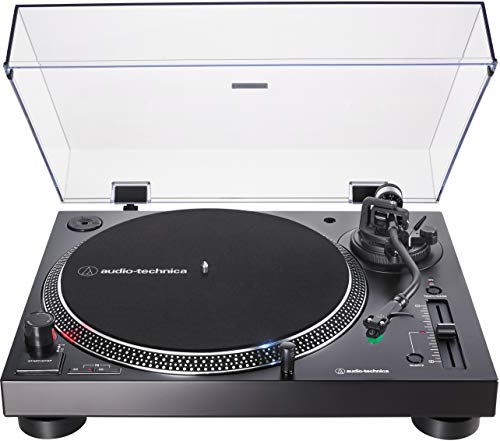
The Audio-Technica AT-LP120XUSB is one of the best-known direct-drive turntables sold in the United States, and it earns that reputation by combining three things that rarely come together in one deck: the stable, high-torque feel of a direct-drive motor, a phono preamp you can switch on or off, and a USB output. This profile pulls together what Audio-Technica says about the model and adds what independent outlets such as Louder and GearLab reported. We did not handle the turntable ourselves, so everything below is attributed to the manufacturer or to a named outlet.
For the full ranking, see our best turntables of 2026 comparison.
The Short Version
The AT-LP120XUSB is a fully manual, direct-drive turntable. According to Audio-Technica, it updates the earlier AT-LP120-USB with a new DC servo direct-drive motor, adjustable dynamic anti-skate control and a selectable phono preamp. It plays 33-1/3, 45 and 78 RPM records and sends audio out either over a detachable dual RCA cable or over USB to a computer.
That mix makes it a flexible first serious turntable. A beginner can use the built-in preamp to plug into powered speakers. A collector can later switch the preamp off and use a better phono stage. A DJ can use the pitch controls. If you want a hands-off, one-button player, the Audio-Technica AT-LP60X profile is the simpler choice. For the DJ side, the Audio-Technica AT-LP140XP profile covers its DJ-focused sibling, and the Technics SL-1200MK7 profile covers the club standard.
Key Specs According to Audio-Technica
These details come from Audio-Technica’s US product page for the AT-LP120XUSB (archived copy, linked in Sources).
- Type: 3-speed, fully manual operation.
- Motor and drive: DC servo motor, direct drive.
- Speeds: 33-1/3, 45 and 78 RPM.
- Platter: Die-cast aluminum with a felt mat.
- Starting torque: More than 1.0 kgf-cm, with an electronic brake.
- Tonearm: Balanced S-shaped arm with a detachable headshell, hydraulically damped lift control and a lockable rest. Effective arm length is about 9.07 inches (230.5 mm), overhang is about 0.63 inches (16 mm) and tracking error angle is under 3 degrees.
- Cartridge: AT-VM95E Dual Magnet with a 0.3 x 0.7 mil elliptical stylus, mounted on an AT-HS6 universal half-inch headshell.
- Phono preamp: Built in and switchable between PHONO and LINE. Audio-Technica lists 4 mV nominal output on PHONO and 240 mV on LINE, with 36 dB nominal gain and RIAA equalization.
- USB: 16-bit, 44.1 or 48 kHz selectable, USB 1.1 compliant, for Windows 7 or later and macOS.
- Pitch: Quartz-controlled pitch lock and a slider with +/-8% or +/-16% ranges, plus a stroboscopic platter and a removable plug-type target light.
- Power: External AC adapter rated 100 to 240 V, 50/60 Hz, so it runs on a standard US 120 V outlet.
- Size and weight: About 17.80 x 13.86 x 5.57 inches (452 x 352 x 141.6 mm) and 17.6 lb (8 kg) without the dust cover.
- In the box: USB cable, detachable dual RCA cable with ground wire, AC adapter, 45 RPM adapter, counterweight, felt mat and a removable hinged dust cover.
The page does not list a wow and flutter figure, so we do not quote one. Audio-Technica also does not give a recommended tracking force on that page. Louder cites 1.8 to 2.2 g as the recommended range for the VM95E cartridge, which is the figure to check against Audio-Technica’s cartridge documentation before you set the counterweight.
What You Get From Direct Drive
On a belt-drive deck, a rubber belt connects the motor to the platter. On a direct-drive deck like this one, the motor sits under the platter and turns it directly. The practical effects are the ones Louder describes: higher torque, better control when cueing and playing records in time with one another, and a platter that reaches speed quickly.
Louder’s writer, who received a unit directly from Audio-Technica, found the turntable “extremely stable” and described near bump-proof playback, with the needle staying put even when he was moving around the room or knocking his DJ mixer on the same surface. He credited the quartz-controlled speed regulator for steady playback speed. Louder also noted the damped feet and the mass of the deck.
GearLab’s page paints a more measured picture on vibration. In its comparison, the AT-LP120XUSB scored 6 out of 10 for vibration resistance, and GearLab reported that the needle skipped fairly easily when the table was bumped, although it stood up to most stomping and dancing nearby. That page carries a December 2017 date and lists the older AT95E cartridge in its specification table, so read it as a snapshot of the earlier version of this deck, not of the current VM95E model. The lesson that holds for any turntable is the same: put it on a solid, level piece of furniture, away from your speakers.
The Built-In Phono Preamp, Explained
A turntable cartridge produces a very small signal, and it needs a phono preamp to boost it and apply RIAA equalization before it reaches a speaker or receiver. Many receivers have a dedicated PHONO input that does this. Powered speakers and most Bluetooth speakers do not.
The AT-LP120XUSB covers both cases. With the preamp set to LINE, it outputs a line-level signal that any AUX or line input accepts, so it works with powered speakers or a receiver without a phono input. With the preamp set to PHONO, it passes the raw cartridge signal along to a receiver that has a PHONO input or to an outboard phono stage.
Louder’s writer thought it sounded good even through the built-in preamp, while noting that built-in preamps on budget turntables are not usually the highlight. He suggested the main upgrades are a better stylus, a new cartridge on the half-inch headshell, or a separate phono stage. That is a sensible path: start with the built-in preamp, and upgrade it only if you decide you want more.
USB Recording
The USB output is what separates this model from many other direct-drive decks. Audio-Technica says you can download free Audacity software for Mac or PC and convert your records into digital audio files. This is handy for rare or out-of-print records, or if you want a copy for your phone.
There is a caveat. Louder’s writer recorded into the Reaper digital audio workstation, found it close to one-touch, and then heard a persistent, quiet, high-pitched whine in the USB recording, audible between tracks and in quiet passages. He said the whine was not present during regular playback through the analog outputs, and he guessed it came from interference from the motor circuitry, though he stressed it was only a guess. It cost the model full marks in his write-up. If digitizing is your main reason to buy, weigh that. For listening alone, it does not apply.
GearLab’s page, again describing an earlier version, noted that digital conversion is somewhat time-consuming but a nice option for a rare record you want to digitize.
Setup: What a Manual Turntable Asks of You
Fully manual means you lift the tonearm, move it over the record and lower it with the cue lever. It does not have an auto-return. Audio-Technica describes a balanced S-shaped tonearm with hydraulically damped lift control, and GearLab’s page said the cue lever lowers the needle slowly, so you do not have to do it by hand.
Louder was candid about calibration. The counterweight needs to be set for the cartridge’s tracking force, the cartridge needs to line up with the groove, and anti-skate needs to counteract the inward pull on the arm. The writer found the cartridge close to aligned out of the box, and measured about 1.3 g at the counterweight’s detent, which is below the recommended 1.8 to 2.2 g for the VM95E. He suggested balancing the arm and then advancing the numbered dial to 2 for an approximation, and noted that a tracking force gauge is more precise. A cheap digital stylus gauge is a worthwhile accessory.
Practical setup in a US home:
- Pick a sturdy, level shelf or stand that is not shared with your speakers.
- Attach the platter, felt mat and counterweight following the manual.
- Set tracking force and anti-skate, ideally with a gauge.
- Set the preamp switch to LINE for powered speakers or to PHONO for a receiver with a phono input.
- Plug the AC adapter into a standard outlet and connect the RCA cable. Use the ground wire if your receiver has a ground terminal, which helps avoid hum.
Upgrade Path
The AT-VM95E is part of a family. Audio-Technica says it is compatible with any VM95 Series replacement stylus, offering a wide choice for every budget and application. Louder points to a higher-end stylus as one of the main ways to improve this deck. Audio-Technica lists a replacement stylus, the AT-VMN95E, among related products on the page.
The half-inch standard headshell mount also allows a different cartridge entirely, and the removable headshell makes swapping easy. Keep in mind that a conical stylus is common for DJ use and an elliptical one for listening, which is a trade-off we explain in our DJ turntable guide.
Who Should Buy It
- First-time buyers who want room to grow. You can start with powered speakers and later move to a receiver and separate phono stage without replacing the turntable.
- Collectors with older records. The 78 RPM setting and pitch control are useful if you collect older or odd records. Louder points out that fine pitch control can be handy for records with wonky masters.
- People who want to digitize records. The USB output is built in.
- Aspiring DJs. It has the direct drive, pitch lock, strobe and target light, but if you plan to mix seriously, compare the AT-LP140XP and the Technics SL-1200MK7.
Who Should Skip It
- Anyone who wants a fully automatic player. The AT-LP120XUSB is manual. The AT-LP60X and the Sony PS-LX310BT are better matches.
- Anyone who wants Bluetooth. This model has analog and USB outputs only on Audio-Technica’s page.
- People with very little space. At 17.6 lb and about 18 inches wide, it needs a proper surface.
Our Take
We rank the AT-LP120XUSB in the middle of our selection: it costs more than the simple automatic players and less than the premium direct-drive and belt-drive decks. Its strongest argument is flexibility. GearLab’s older page called it a best choice for most people, and Louder called it a great shout for solid performance at the entry level. Both outlets looked at a specific unit, so treat their conclusions as context for your own decision rather than a guarantee.
Sources