We earn a commission if you buy through our links, at no extra cost to you.
Best DJ Turntable for Beginners: Direct-Drive Picks
What a beginner DJ needs from a turntable: direct drive, torque, pitch range, reverse, a DJ cartridge and a mixer with phono inputs, plus three decks that fit.
At a glance
For a beginner DJ, the Audio-Technica AT-LP140XP is the approachable pick, with high-torque direct drive, reverse play and three pitch ranges. The Technics SL-1200MK7 is the club standard for those who want to go further, and the Audio-Technica AT-LP120XUSB adds a built-in phono preamp for home use. The first two need a mixer with phono inputs.
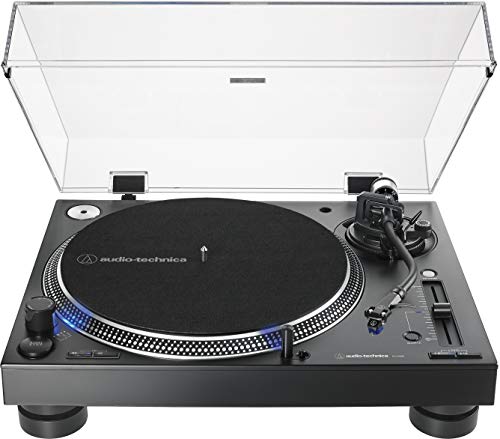

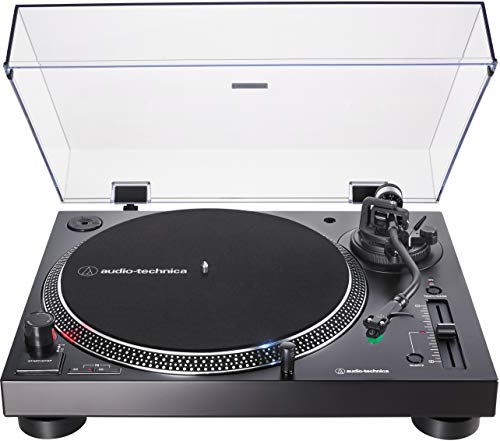
Search for “DJ turntable for beginners” and the same short list keeps appearing: direct-drive decks with a pitch slider, built on the layout Technics made standard. A DJ turntable is not just a record player with extra buttons. It is built to hold a record still, start fast, and match its speed to another record. This guide explains the features that matter and matches them to three decks. It is written for adults starting out at home, with a mixer and a pair of decks in mind.
We did not handle these turntables ourselves. The guide compares manufacturer specifications and the findings of independent outlets, which we attribute by name. For the full lineup, see our best turntables of 2026 comparison.
Why DJs Use Direct Drive
On a belt-drive turntable, a rubber belt connects the motor to the platter. On a direct-drive turntable, the motor sits under the platter and turns it directly. Technics explains that its direct-drive system uses a slow-turning motor to directly drive the platter, offering rotation accuracy and powerful torque, and that it requires no replacement of parts. Louder puts the benefit in DJ terms: the higher torque gives better control of cueing and of playing records in time with one another.
Torque is how strongly the platter starts and holds its speed when you touch the record. The makers list starting torque differently, so compare with care: Audio-Technica lists more than 2.2 kgf-cm for the AT-LP140XP and more than 1.0 kgf-cm for the AT-LP120XUSB, and Panasonic’s spec sheet for Technics lists 1.8 kgf-cm for the SL-1200MK7 with a 0.7 second build-up from standstill to 33-1/3 RPM. Technics also lets you adjust torque and brake speed in four levels.
Pitch Range, Reverse and Speeds
- Pitch control. The slider speeds up or slows down playback so you can match the tempo of two records. The Technics SL-1200MK7 offers +/-8% and +/-16%. The AT-LP140XP offers +/-8%, +/-16% and +/-24%. The AT-LP120XUSB offers +/-8% and +/-16%, with a quartz lock that holds exact speed.
- Reverse play. The AT-LP140XP and the SL-1200MK7 both list reverse play for effects. Technics says this is the first time it has appeared in the SL-1200 series. The AT-LP120XUSB does not list it.
- Speeds. All three decks list 33-1/3, 45 and 78 RPM; Technics provides 78 with a switch.
- Strobe and target light. Audio-Technica lists a stroboscopic platter with speed indicator and a target light for cueing in low light on the AT-LP140XP and the AT-LP120XUSB. The Technics pages we read do not list either.
Tonearm, Headshell and Cartridge
DJ turntables typically use an S-shaped tonearm with a removable headshell. The headshell holds the cartridge and screws onto the arm, so you can swap cartridges without changing the whole arm. Audio-Technica fits the AT-HS6 half-inch headshell on its two decks, and Technics supplies a headshell and a screw set for the cartridge.
DJs also use a different type of stylus. The AT-LP140XP comes with the AT-XP3 DJ cartridge, which Audio-Technica describes as durable and high output, with a 0.6 mil conical bonded stylus. The AT-LP120XUSB comes with the AT-VM95E, which has a 0.3 x 0.7 mil elliptical stylus aimed more at listening. The Vinyl Factory heard the AT-LP140XP’s DJ cartridge as strong in bass and found that a hi-fi Ortofon 2M Red gave a more elegant sound, so there is a trade-off between DJ use and listening.
Technics’ accessories list includes a headshell and a screw set for the cartridge but names no cartridge. Plan to buy one that suits your weight range: Technics lists an applicable cartridge weight range of 5.6 to 12.0 g without the headshell.
The Phono Preamp: Where DJs Differ From Home Listeners
Home turntables often have a built-in phono preamp. DJ decks usually do not. Audio-Technica says the AT-LP140XP is designed to connect to components with a dedicated phono input, and the Vinyl Factory notes that, unlike the AT-LP120, it has no built-in phono amplifier or USB. Technics lists a phono output with a ground terminal.
That is not a problem if you use a DJ mixer with phono inputs, which most do. Set the channel input to PHONO, connect the ground wire so there is no hum, and you are ready. If you want to use your deck at home with powered speakers, you need a separate phono preamp, or a deck like the AT-LP120XUSB that has one built in.
Two Decks, Slipmats and Setup
To blend one record into the next you need two turntables and a mixer. You can learn cueing and pitch control on one deck first, and add a second later, but match your decks when you can, so the platters and arms behave the same way.
- Slipmat. A slipmat lets the record slide on the platter while the platter keeps spinning. Technics includes a slipmat and slipsheet with the SL-1200MK7, and Audio-Technica includes a felt mat with its decks.
- Surface. DJ decks are heavy: the AT-LP140XP is 22 lb (10 kg), the SL-1200MK7 is 21.2 lb (9.6 kg) and the AT-LP120XUSB is 17.6 lb (8 kg). Use a strong table and keep the speakers off it. Louder praised the AT-LP120XUSB’s stability, even when its writer was bashing around the room or knocking a mixer on the same surface.
- Power. The AT-LP140XP lists 115/230 V, the SL-1200MK7 lists 110 to 240 V and the AT-LP120XUSB lists 100 to 240 V, so a standard US outlet works for all three.
- Dust cover. The Vinyl Factory advises removing the AT-LP140XP’s cover during play to avoid additional vibration.
- Tracking force. Set it with a stylus gauge. The Vinyl Factory heard the AT-LP140XP’s cartridge as better balanced at about 2 g than at the 3 g it is supposed to be set at. Check Audio-Technica’s manual for the official range.
Audio-Technica AT-LP140XP: The Approachable DJ Deck
High-torque direct drive, forward and reverse play, three pitch ranges and an AT-XP3 DJ cartridge. A beginner's route to the Technics layout.
Audio-Technica calls it a fully manual professional DJ turntable. It has a quartz pitch lock, a stroboscopic platter, a pop-up target light and a 22 lb body. The Vinyl Factory called it a heavy-chassis deck with strong bass, more lifestyle than audiophile. It has no preamp and no USB, so you need a mixer or a phono input. See the AT-LP140XP profile.
Technics SL-1200MK7: The Club Standard
The deck most DJs know: coreless direct drive, adjustable torque and brake, reverse play, +/-8% and +/-16% pitch and a heavy, damped cabinet.
Technics calls the SL-1200 series the go-to choice of DJs worldwide. The MK7 uses a coreless direct-drive motor, lists wow and flutter of 0.025% WRMS, and has an aluminum die-cast chassis with high-damping insulators. It needs a mixer or phono input and a cartridge you choose yourself. It is the one to pick if you are sure DJing is your hobby. See the Technics SL-1200MK7 profile.
Audio-Technica AT-LP120XUSB: One Deck for DJing and Home Listening
Direct drive with pitch control, a strobe, a built-in switchable preamp and USB. Works as a DJ deck and as a home turntable.
Louder calls it a DJ-friendly record player that takes after the Technics 1210. It lists +/-8% and +/-16% pitch and a quartz lock, and the built-in preamp lets you connect to powered speakers when you are not mixing. It has no reverse play, and its torque is listed lower than the AT-LP140XP’s. See the AT-LP120XUSB profile.
Which One Should You Buy?
- Learning to DJ on a budget: the AT-LP140XP.
- Serious about DJing and want the standard: the Technics SL-1200MK7.
- One deck for both practice and home listening: the AT-LP120XUSB.
- First record player, not a DJ: see our beginner turntable guide.
Sources
Frequently asked questions
What is the best type of turntable for a beginner DJ?
A direct-drive turntable, where the motor sits under the platter and turns it directly. Audio-Technica and Technics both build their DJ decks this way, and Louder explains that the higher torque of direct drive gives better control of cueing and of playing records in time with each other.
Do I need two turntables to DJ?
To mix one record into another, yes. Two turntables and a DJ mixer let you match speeds and blend. You can practice cueing and pitch control on one deck first.
Do DJ turntables have a built-in phono preamp?
Usually not. The Audio-Technica AT-LP140XP is designed to connect to components with a dedicated phono input, and the Technics SL-1200MK7 lists a phono output. Plug them into the PHONO inputs of a DJ mixer. The AT-LP120XUSB is the exception, with a switchable built-in preamp.
What does pitch range mean?
It is how far the pitch slider can speed up or slow down the record. The Technics SL-1200MK7 lists +/-8% and +/-16%. The Audio-Technica AT-LP140XP lists +/-8%, +/-16% and +/-24%, and the AT-LP120XUSB lists +/-8% and +/-16%.
Why do DJ decks use a conical stylus?
Audio-Technica describes the AT-XP3 on the AT-LP140XP as a durable, high-output DJ cartridge with a 0.6 mil conical bonded stylus. DJ cartridges are made for cueing and handling. Listening cartridges usually use an elliptical stylus, like the one on the AT-LP120XUSB.
Is the Technics SL-1200MK7 too much for a beginner?
It is the club standard, but it is also a sizeable investment. Technics lists adjustable torque and brake, reverse play and 78 RPM, and the unit weighs about 21.2 lb. If you are unsure DJing is for you, the AT-LP140XP covers the same ground for less.