We earn a commission if you buy through our links, at no extra cost to you.
Best Turntable for Beginners: Picks for a First Player
Choosing a first record player: phono preamp, powered speakers vs receiver, automatic vs manual, Bluetooth, USB and stylus basics, with five picks that fit.
At a glance
For a first record player, the Audio-Technica AT-LP120XUSB is the flexible pick with a built-in phono preamp and USB. The Sony PS-LX310BT adds automatic playback and Bluetooth, and the Audio-Technica AT-LP60X is the simplest start with powered speakers. The Pro-Ject Debut EVO 2 is the step up for a hi-fi system.
Most first-time buyers search for “turntable for beginners” and find a wall of near-identical black decks. The differences that matter are not about looks. They are about what the turntable plugs into, how much setup it asks for, and whether you can improve it later. This guide explains those choices in plain English, then matches them to five turntables.
We did not handle these turntables ourselves. The guide compares manufacturer specifications and the findings of independent outlets, which we attribute by name. For the whole lineup, see our best turntables of 2026 comparison.
The First Question: How Will It Connect?
You cannot plug a turntable straight into just any speaker. The cartridge produces a very small signal, so it needs a phono preamp (also called a phono stage) to boost it and apply RIAA equalization, the standard curve used when records are cut. There are three ways to get one:
- A turntable with a built-in phono preamp. The Audio-Technica AT-LP120XUSB and AT-LP60X list a switchable preamp, and the Sony PS-LX310BT lists a built-in phono EQ. With the preamp on, you can plug into powered speakers, computer speakers or the AUX input of a receiver.
- A receiver or amplifier with a PHONO input. This is the classic stereo route. You switch the preamp off, or buy a turntable without one, and use the receiver’s own.
- A separate phono preamp. A small box between the turntable and any line-level input. Fluance says its RT82 requires a phono preamp to function, and sells a bundle with its PA10.
If you plan to use powered speakers or Bluetooth speakers and do not want extra boxes, pick a turntable with a built-in preamp. If you already own a receiver with a PHONO input, or want to build a hi-fi system over time, a turntable without a preamp is fine and often leaves room to improve.
Check the input on your speakers too. The AT-LP60X ships with an RCA cable that ends in a 3.5 mm plug on one side, according to Audio-Technica, which suits some powered speakers directly.
Automatic or Manual?
A fully automatic turntable moves the arm onto the record when you press start and returns it at the end. A manual turntable asks you to lift the arm, move it over the record and lower it with a cue lever.
Automatic is easier and friendlier for a household where several people use it. Sony describes one-step playback on the PS-LX310BT, and Audio-Technica describes the AT-LP60X as fully automatic. What Hi-Fi noted that the Sony has no cartridge to fit and align, no tracking force or anti-skate to set, and no need for an alignment record.
Manual turntables give you a standard headshell, adjustable tracking force and often an upgradeable cartridge. The Audio-Technica AT-LP120XUSB, the Fluance RT82 and the Pro-Ject Debut EVO 2 are manual. Louder points out that a deck like the AT-LP120XUSB needs calibration: set the counterweight, check the cartridge alignment and set anti-skate. A digital stylus gauge makes it easier.
Do You Need Bluetooth or USB?
Bluetooth lets the turntable send sound to wireless speakers, soundbars or headphones. Among our picks, only the Sony PS-LX310BT has it, and Sony reminds buyers that interoperability among Bluetooth devices varies. What Hi-Fi’s writers heard a strong connection with headphones at about 49 feet (15 m). If your speakers are wireless, this is the feature that makes a first record player work.
USB lets you record a record to your computer. Audio-Technica says the AT-LP120XUSB’s USB output works with free Audacity software on Mac and PC. Louder heard a faint whine in the USB recording that was not present in normal playback. Sony Canada’s North American spec sheet lists a USB Type-B port on the PS-LX310BT, although What Hi-Fi’s UK unit was described without one. If digitizing matters, check the listing.
If you do not need either, skip both and put your attention on the preamp and the cartridge.
Cartridge and Stylus Basics
The cartridge holds the stylus, the diamond tip that reads the groove. It is the part that wears out, and the part most worth knowing about.
- Replaceable stylus. The AT-LP60X uses the ATN3600LC, with an optional elliptical ATN3600LE. The AT-LP120XUSB’s AT-VM95E accepts any VM95 Series stylus. The Fluance RT82’s Ortofon OM 10 uses the Ortofon Stylus 10.
- Integrated or swappable cartridge. The AT-LP60X builds the cartridge into the headshell, so you replace the stylus but not the cartridge. The AT-LP120XUSB and the RT82 use a standard half-inch mount, so you can fit another cartridge. The Sony PS-LX310BT has no exchangeable headshell.
- Tracking force. This is how hard the stylus presses on the record, set by the counterweight. Automatic decks set it for you. On manual decks, Fluance says the RT82’s stylus needs about 1.5 g, and Louder cites 1.8 to 2.2 g for the VM95E. Always check the manual.
- Anti-skate. A small counter-force that stops the arm drifting inward. Manual decks have an adjustment.
33, 45 and 78 RPM
Most albums play at 33-1/3 RPM, and many singles at 45. Older shellac records play at 78 RPM and need a different stylus size from modern vinyl. Only the Audio-Technica AT-LP120XUSB lists 78 RPM among our picks. The others play 33-1/3 and 45. If you have a box of old 78s, that is a reason to choose the AT-LP120XUSB, or to ask a record shop before you play them.
Setting Up in a US Home
- Surface. Use a sturdy, level shelf or stand. A turntable picks up vibration from footsteps and from speakers on the same surface, so keep the speakers off it.
- Power. The Audio-Technica, Sony and Fluance decks list 100 to 240 V power, so a standard US 120 V outlet is fine. Check the Pro-Ject’s adapter in its manual.
- Ground. If your receiver or preamp has a ground terminal, connect the turntable’s ground wire to it. This helps prevent hum.
- Dust cover. Sony says the thicker cover on the PS-LX310BT muffles acoustic pressure from your speakers and can also be removed. Put the covers back on when you are not playing.
- Records. The Library of Congress advises handling grooved discs by the edge and label areas only and storing them upright.
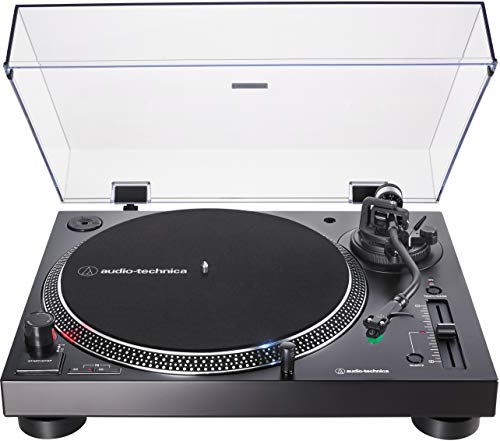
Audio-Technica AT-LP120XUSB: The Flexible First Deck
A manual direct-drive deck with a switchable phono preamp, USB output and 78 RPM. A good pick if you want room to grow.
According to Audio-Technica, it is fully manual with a DC servo direct-drive motor, plays 33-1/3, 45 and 78 RPM, and has a built-in switchable phono preamp and a USB output. The AT-VM95E cartridge takes the VM95 Series stylus range. You can start with powered speakers, and later switch the preamp off and use a receiver or separate phono stage. The trade-offs are setup effort, a deck that weighs 17.6 lb, and the USB whine Louder heard. See the AT-LP120XUSB profile.
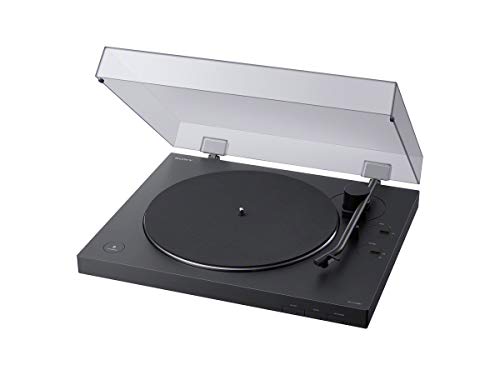
Sony PS-LX310BT: Automatic and Wireless
A fully automatic belt-drive deck with Bluetooth and a built-in phono preamp. Made for wireless speakers and headphones, with no setup.
Sony lists auto start, auto return, an aluminum platter of about 11.7 in (296 mm), 33-1/3 and 45 RPM, and a phono/line selector with gain select. What Hi-Fi found setup took under five minutes. The trade-offs are no 78 RPM, no exchangeable headshell and, to What Hi-Fi’s ears, some woolliness next to purist manual decks. See the Sony PS-LX310BT profile.
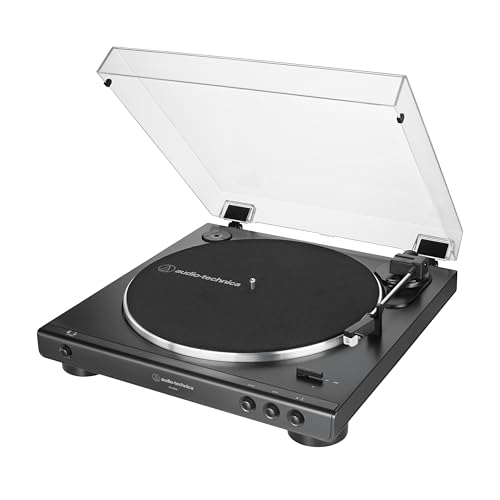
Audio-Technica AT-LP60X: The Simplest Start
A light, fully automatic belt-drive deck with a built-in preamp. Plugs into powered speakers and plays right away.
Audio-Technica calls it an affordable, easy-to-use turntable. It weighs 5.73 lb, plays 33-1/3 and 45 RPM, and has a replaceable stylus. The cartridge is integrated into the headshell, there is no Bluetooth or USB, and there is no 78 RPM. It suits a gift or a small space. See the AT-LP60X profile.
Fluance RT82: A First Hi-Fi System

A manual belt-drive deck with an Ortofon OM 10 cartridge and an MDF plinth. For buyers who already have a phono input or plan to buy a preamp.
Fluance lists a servo motor, 0.07% wow and flutter, a half-inch cartridge mount and a two-year warranty. It has no built-in preamp, no Bluetooth and no 78 RPM. It makes sense if you are starting a hi-fi system around a receiver. See the Fluance RT82 profile.
Pro-Ject Debut EVO 2: The Step Up
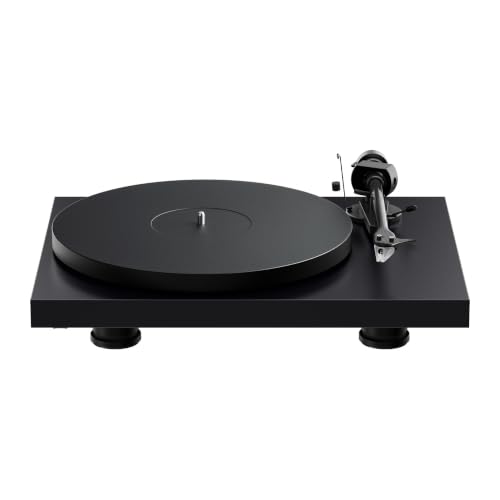
A premium manual belt-drive deck with a carbon tonearm and electronic speed change. A step up for a first deck that you plan to keep.
Pro-Ject lists a die-cast aluminum platter of about 11.8 in (300 mm) with TPE damping, an 8.6-inch one-piece carbon tonearm and a Pick it MM EVO cartridge developed with Ortofon. Tom’s Guide notes it has no USB, Bluetooth or automatic operation and needs a phono preamp or a receiver. It sits well above the other picks, and is for buyers who already know they want a hi-fi setup. See the Pro-Ject Debut EVO 2 profile.
Quick Chooser
- Powered or Bluetooth speakers, no fuss: the Sony PS-LX310BT (Bluetooth) or the AT-LP60X (wired).
- Powered speakers now, a receiver later: the AT-LP120XUSB.
- A receiver with a phono input and a hi-fi plan: the Fluance RT82, or the Pro-Ject Debut EVO 2 as a step up.
- Old 78 RPM records: the AT-LP120XUSB.
- Want to DJ: see our beginner DJ turntable guide.
Sources
- Audio-Technica AT-LP120XUSB product page (archived copy)
- Audio-Technica AT-LP60X product page (archived copy)
- Sony PS-LX310BT US product page (archived copy)
- Sony Canada PS-LX310BT specifications (archived copy)
- Fluance RT82 official product page
- Pro-Ject Debut EVO 2 official product page
- What Hi-Fi: Sony PS-LX310BT
- Tom’s Guide: Pro-Ject Debut EVO 2
- Louder: Audio-Technica AT-LP120XUSB
- Library of Congress: Care, Handling, and Storage of Records
Frequently asked questions
What do I need besides a turntable to play records?
You need a way to amplify and hear the signal: powered speakers, or a receiver or amplifier with speakers. The signal from a cartridge is also very small, so it needs a phono preamp. Some turntables, such as the Audio-Technica AT-LP120XUSB, AT-LP60X and Sony PS-LX310BT, have one built in. A receiver with a PHONO input also has one.
What is a phono preamp?
A phono preamp boosts the tiny signal from a turntable cartridge and applies RIAA equalization, the standard curve used when records are cut. Without it, the sound is very quiet and thin. Audio-Technica lists its AT-LP120XUSB and AT-LP60X with a built-in switchable phono preamp, and Fluance says its RT82 needs a separate one.
Is a fully automatic turntable better for a beginner?
It is easier. A fully automatic deck such as the Sony PS-LX310BT or the Audio-Technica AT-LP60X lowers and lifts the arm for you and has nothing to balance. What Hi-Fi noted that automatic arms offer little scope for cartridge upgrades on the Sony. A manual deck asks for more setup and rewards you with more flexibility.
Do I need Bluetooth on a turntable?
Only if you want to listen on wireless speakers or headphones. Sony's PS-LX310BT sends audio over Bluetooth and also has a wired output. Sony notes that compatibility among Bluetooth devices varies. A wired connection to powered speakers or a receiver has fewer variables.
Can I play my old 78 RPM records?
Only on a turntable that lists 78 RPM, such as the Audio-Technica AT-LP120XUSB, and ideally with a stylus suited to 78s. The Sony PS-LX310BT, the AT-LP60X, the Fluance RT82 and the Pro-Ject Debut EVO 2 play 33-1/3 and 45 RPM only, according to their makers.
How often should I replace the stylus?
It depends on use, so follow the cartridge maker's guidance. Audio-Technica lists replacement styli for its decks, such as the ATN3600LC for the AT-LP60X, and the VM95 Series for the AT-LP120XUSB, and Fluance lists the Ortofon Stylus 10 for the RT82. Keeping records clean helps protect the stylus.