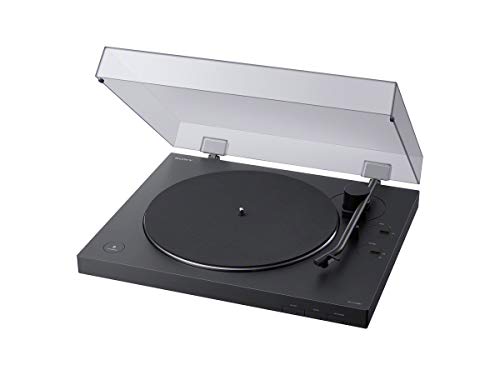
The Sony PS-LX310BT is built for a very specific buyer: someone who wants to put on a record and hear it, preferably through a Bluetooth speaker or headphones, without learning what a counterweight is. It is a fully automatic, belt-drive deck with a built-in phono preamp and Bluetooth, and it is still sold by Sony in the US. This profile summarizes what Sony says and what What Hi-Fi reported from its own listening. We did not handle the turntable ourselves.
For the full ranking, see our best turntables of 2026 comparison.
The Short Version
The PS-LX310BT is about convenience. According to Sony, the turntable lowers the tonearm, finds the groove and starts the music playing, and when the record ends the arm returns to rest on its own. It supports phono and line output thanks to its built-in phono EQ, and Bluetooth connectivity lets you listen on wireless speakers or headphones.
If you want to grow into hi-fi, with a better cartridge and a tuned tonearm, this is not that deck. The Audio-Technica AT-LP120XUSB profile covers a manual deck with an upgrade path, and the Fluance RT82 profile covers a belt-drive manual deck for a first hi-fi system. If you want an even simpler automatic player with wired output, see the Audio-Technica AT-LP60X profile.
Key Specs According to Sony
These details come from Sony’s US product page and Sony Canada’s specification sheet (both archived copies, linked in Sources). The US page lists only high-level features, so most numbers below come from the Sony Canada sheet, which describes the same model number.
- Drive: Belt drive.
- Speeds: 33-1/3 and 45 RPM, with a 45 RPM adapter stored beneath the deck.
- Platter: Die-cast aluminum, about 11.7 inches (296 mm) across.
- Tonearm: Aluminum pipe with a straight design. No exchangeable headshell.
- Cartridge: Moving magnet (MM) type.
- Operation: Auto start, auto return and auto stop.
- Outputs: RCA cable, with a built-in phono preamp and a phono/line selector switch. Gain select is Low (-4 dB), Mid (0 dB) or High (+6 dB). Sony Canada lists no earth terminal.
- Bluetooth: Yes, for wireless speakers, soundbars and headphones.
- USB: Sony Canada’s North American spec sheet lists a Type-B USB output port. See the FAQ about What Hi-Fi’s UK description.
- Power: AC adapter rated 100 to 240 V, 50/60 Hz, 1.8 W power consumption, so it runs on a US 120 V outlet.
- Size and weight: About 17 x 4-3/8 x 14-1/2 inches (430 x 108 x 367 mm) and roughly 7 lb 11-1/2 oz (3.5 kg).
- Dust cover: Sony describes a thicker dust cover that muffles acoustic pressure from speakers and can be removed.
Sony’s pages do not list a wow and flutter figure, a tracking force or the cartridge model, so we do not quote them. That also means you cannot look up a specific replacement stylus from the specs we read. Check Sony’s support pages for a replacement stylus before you buy.
What Fully Automatic Means in Practice
On a manual turntable you lift the tonearm and lower it by hand, then lift it again at the end. A fully automatic deck does this with a motor. Sony’s “one-step” playback means you press a button, the arm moves out, finds the groove and lowers itself, and returns at the end of the side.
What Hi-Fi’s writers noted that the buttons that operate the fully automatic arm may feel slightly clunky, but are sufficient at this price. They also pointed out that for vinyl veterans, lifting and lowering the arm is part of the ritual, while those who want to spin a tune quickly and easily will find the buttons a bonus. It also helps protect a record and stylus from a shaky hand, since the cueing is done for you.
The trade-off is that automatic arms are not designed for tinkering. Sony lists no exchangeable headshell, and What Hi-Fi warned that the design of the arm leaves little scope for cartridge upgrades. The same outlet noted the stylus cover needs careful handling: the delicate assembly came away in its hands on the first removal, though it goes back on easily. Take your time when unpacking it.
What What Hi-Fi Found
What Hi-Fi published its own listening and setup notes in its UK edition, and those are the main independent source we found for this model.
- Setup. What Hi-Fi’s writers plugged the turntable into the wall and were listening to music on Bluetooth headphones in under five minutes. Apart from fitting the belt to the platter, there was nothing to do: no cartridge to fit and align, no tracking force or anti-skate to set, and no calibration disc needed.
- Bluetooth. It can be paired with up to eight Bluetooth devices. In listening with headphones, the connection was strong enough to walk into another room, close the door and even go outside, at least 49 feet (15 m) away.
- Sound. Through a reference system, the writers heard emotion in the vocals and clear, tight bass on a rock album, with a healthy dose of drive and attack. Compared with purist, fully manual decks, they heard a woolliness in the dynamics and a loss of clarity between notes, and wanted more dynamic punch on a 45 RPM single.
- A tip. If you already own an integrated amplifier or a dedicated phono preamp, What Hi-Fi recommends switching the line-out switch to phono and using that instead of the built-in stage.
- Verdict. What Hi-Fi summed it up as a deck with oodles of features, effortless usability and entertaining sound.
That outlet’s pricing was in pounds and is not relevant here, so we do not repeat it.
Bluetooth and the Phono Preamp, Explained
Two features make the PS-LX310BT work for beginners.
Built-in phono preamp. A cartridge’s signal is too weak for a normal speaker input, so it needs a phono preamp. Receivers with a PHONO input have one, and powered speakers usually do not. Sony’s built-in stage lets you plug into powered speakers or the AUX input of a receiver. The gain select lets you match the output level of your records.
Bluetooth. Bluetooth lets you send the sound to wireless speakers, soundbars or headphones. Sony notes that interoperability and compatibility among Bluetooth devices vary, so a speaker from another brand may or may not pair smoothly. Wireless audio is compressed, and a wired connection to a good amplifier will generally give you more headroom for upgrades. If you do not need Bluetooth, a cheaper turntable such as the AT-LP60X gives you the automatic convenience with wired output.
Setup in a US Home
- Place the deck on a stable, level surface away from your speakers. Sony’s thick dust cover is meant to reduce acoustic pressure, but distance still helps.
- Fit the belt on the platter and the platter on the deck, following the manual.
- Remove the stylus cover with care.
- Connect the AC adapter to a standard outlet.
- For wireless listening, pair your Bluetooth speaker or headphones. For wired listening, connect the RCA cable, and set the selector to LINE for powered speakers or AUX inputs, or to PHONO for a receiver with a phono input.
Who Should Buy It
- First-time buyers who want wireless speakers or headphones. It is one of the few decks that handles Bluetooth and an automatic arm together.
- Households where several people will play records. Auto start and auto return reduce the chance of an accidental scratch.
- People who dislike setup. There is no counterweight or anti-skate to adjust.
Who Should Skip It
- Anyone who wants to upgrade the cartridge over time. Sony lists no exchangeable headshell.
- Collectors with old 78 RPM records. The deck plays 33-1/3 and 45 only.
- DJs. It is a belt-drive automatic player, not a performance deck. See our beginner DJ turntable guide.
Sony’s Newer Models
Sony’s US turntable category page, in an archived copy from October 2026, lists the PS-LX310BT next to the newer PS-LX3BT and PS-LX5BT full auto playback turntables with Bluetooth. We did not read specifications for those two, so we cannot compare them. If you are shopping at Sony’s own store, look at them as well.
Our Take
We place the PS-LX310BT in the lower half of our selection, as the Bluetooth and automatic pick. It is a convenient, no-fuss deck that gets records playing on wireless gear quickly. Its limits are clear: it is not upgradeable and, according to What Hi-Fi, it is not as dynamic as purist manual decks. Treat those as honest trade-offs for simplicity.
Sources